
Why 316 Is the Only Real Answer for a Coastal Outdoor Kitche
A specifier's guide to what salt air actually does to steel, where 304 still makes sense, why most failures start at the fasteners rather than the sheet, and what to put in writing before you approve a shop drawing.
Heshan, Guangdong, China — 2 October 2026 —
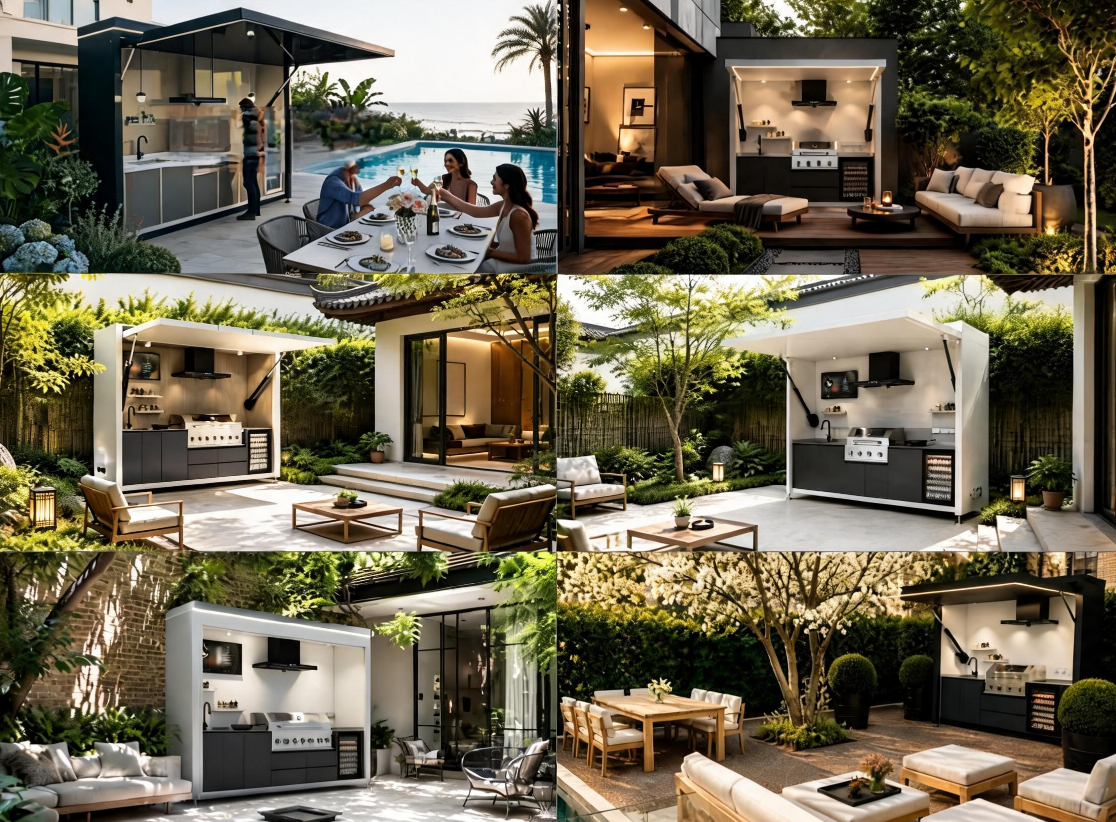
JIUNAI outdoor stainless steel kitchen modules for villas, patios and hotel terraces
What Really Happens to Steel in Salt Air
Stainless steel resists corrosion because of a very thin, self-healing chromium-oxide film on its surface. That film needs oxygen to maintain itself. Salt-laden air undermines it in two ways: chloride ions attack the film locally, and the salt deposit itself holds moisture against the metal, cutting off the oxygen the film needs to repair. Nothing about that process is exotic, and it does not require a hurricane — a seafront terrace with an open aspect provides all the conditions on an ordinary evening.
From tea staining to pitting: the four stages you can inspect for
It is useful to describe corrosion in coastal outdoor kitchens as four stages, because each has a different response. One: surface deposit. Salt film and dust sit on the steel; nothing has happened yet, and a rinse removes it. Two: tea staining. Brown or amber discolouration appears, usually near welds, fasteners or the lower edges where water runs. It is cosmetic and, in most cases, removable. Three: pitting and crevice corrosion. Small, localised attacks begin at a scratch, a heat tint, a fixing or an unsealed lap. This is the stage that matters, because it is no longer cosmetic. Four: section loss. Perforation or loss of material at the pit, usually at a seam or a fixing, requiring component replacement. The practical lesson: stages one and two are maintenance, stage three is a specification failure, and the difference between them is decided long before installation.
316 vs 304: What Changes in the Alloy — and What That Buys You
304 and 316 are both austenitic stainless steels, and both are legitimately food-grade. The difference is roughly 2–3% molybdenum in 316, and that single addition is what improves resistance to chloride pitting and crevice corrosion. It is the same reason marine hardware has conventionally been made from 316 rather than 304.
Molybdenum, chloride resistance and an honest cost comparison
316 costs more than 304, and a specifier deserves an honest framing of that. What you are buying is margin: a materially longer interval before salt exposure turns surface discolouration into pitting, and more tolerance of the detailing mistakes that inevitably happen on site. What you are not buying is immunity. 316 will also tea-stain if salt is left on it, it will also pit if a dissimilar metal is bolted to it without isolation, and it will not rescue a cabinet that holds standing water. If a project is inland, sheltered and maintained, 304 is often the correct and more economical choice; JIUNAI uses 304 food-grade stainless steel as the standard grade and specifies 316 for coastal and high-salinity sites. The honest comparison is between the cost of the upgrade and the cost of replacing an outdoor kitchen on a seafront terrace — not between 316 and perfection.
The Spec You Actually Write: Distance-from-Coast Rules
Distance from the sea is the question every client asks, and the honest answer is that no single number governs it. Exposure is set by wind, shelter, height above ground, proximity to breaking surf, pool chemistry and whether the terrace is washed by rain. Rather than quote a standard we cannot enforce, here is the rule of thumb JIUNAI uses to open the conversation:
A practical exposure map for villas, pool decks and beachfront hotels
- Severe — 316 specified. Open seafront, beachfront hotel terraces, unsheltered roofs and balconies within sight and sound of surf, marina and jetty positions.
- High — 316 specified. Waterfront-set-back plots with a clear wind path to the sea, upper-level terraces with an open aspect, and pool decks using salt-water chlorination where splash reaches the cabinetry.
- Moderate — grade by assessment. Inland coastal communities, sheltered courtyards, and pool decks several metres from the water with shade structures. 304 is frequently appropriate here, 316 where the client wants maximum margin.
- Mild — 304 generally appropriate. Inland, sheltered or fully enclosed positions with no salt path and routine maintenance.
This is a starting point for discussion, not a substitute for assessing the actual site, and every JIUNAI outdoor kitchen is specified from the drawing rather than from a lookup table.
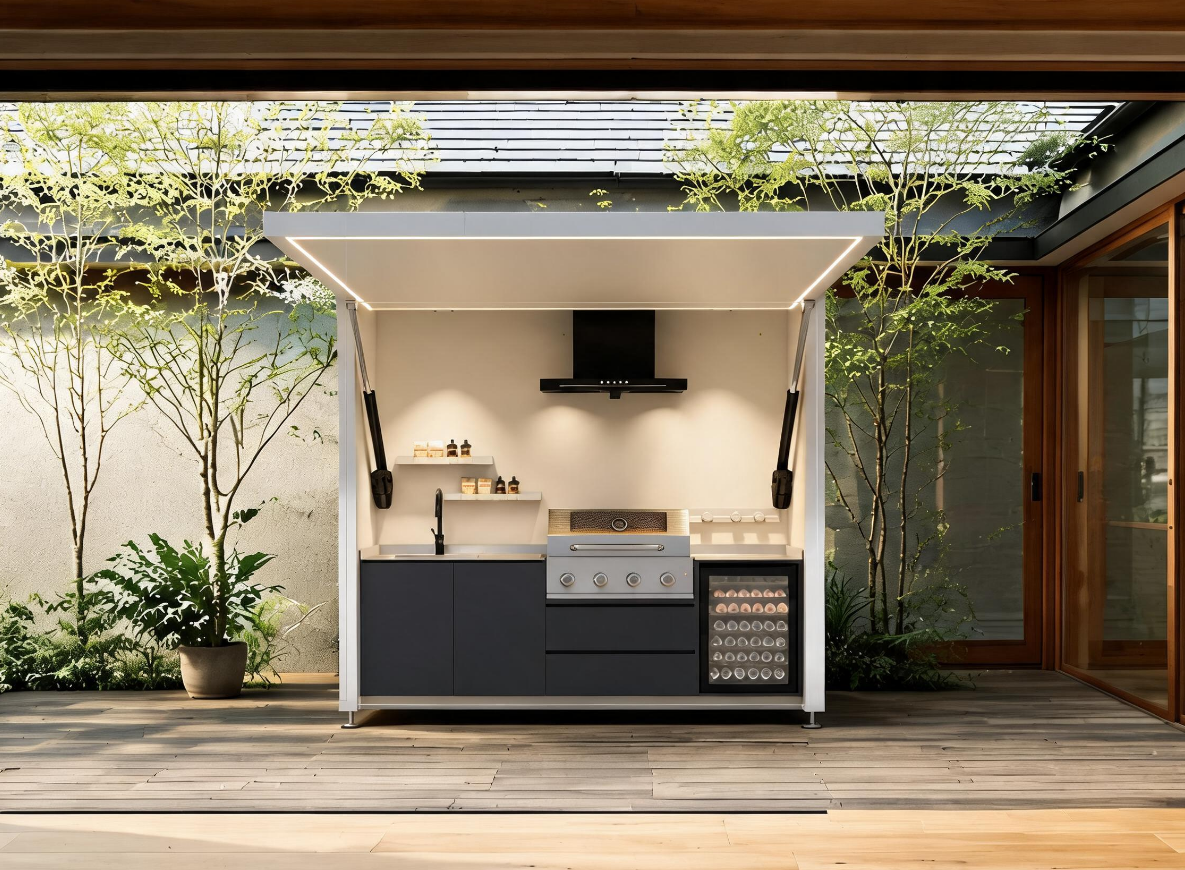
JIUNAI outdoor stainless steel kitchen island on a modern patio
Where Projects Actually Fail (It's Rarely the Sheet Metal)
When a coastal outdoor kitchen fails early, the sheet metal is rarely the culprit. The sheet is usually the thickest, most visible and best-specified part of the assembly. What fails is the detail.
Fasteners, weld seams, cabinet micro-climates and standing water
Fasteners. Hinges, screws and brackets are commonly supplied in a lower grade than the sheet, and a single mismatched screw becomes the pit that stains the door below it. Weld seams and laps. An intermittent or mechanically joined seam is a crevice, and a crevice in a salt environment is where corrosion starts; continuous, laser seamless welding removes most of them. Micro-climates. A cabinet interior that never dries, a sink base with no ventilation, a plinth that traps rainwater — these are small environments in which humidity and salt sit undisturbed for months. Standing water. The most reliable predictor of trouble is whether water can leave. Falls, drainage and sealed penetrations are detailing decisions, and they decide whether the grade you paid for is actually used.
Where Powder Coating Beats Bare 316 — and Where It Doesn't
A coating is a second barrier, and in the right place it is worth having. Powder coating and similar finishes reduce how visible tea staining is, add colour choice, and protect the flat areas that take most of the weather. JIUNAI offers eight finishing processes — Phantom (film lamination), Star (electrostatic powder coating), Bright Moon (powder coating with baking finish), StreamColor (liquid coating with baking finish), Galaxy (crystal glass panel), LUMOJI (wood-grain transfer), Eden (shaped door profile) and Platinum Silent (natural-colour electroplating) — and for outdoor use the standard finishes are Silver and Black Titanium, with availability varying by model.
Where a coating does not help: edges, cut-outs and fixing points, which is where coatings are thinnest and damage starts; high-wear surfaces such as worktops and sink surrounds; and any situation where the coating is expected to compensate for a lower grade underneath. A durable coating on a 304 carcass in a marine exposure is still a 304 carcass. Specify grade first, then finish.
A 6-Point Checklist Before You Approve Any Coastal Outdoor Kitchen
Questions to put in writing to every supplier
1. Is the grade stated in writing for the carcass, the door skin and the hardware separately? A quote that says "stainless steel" has not answered the question.
2. What is behind the steel? Ask for the core material in writing — aluminium honeycomb and aluminium profile inserts behave very differently from a wood-based core when humidity cycles.
3. How are seams joined and treated? Continuous and laser seamless welding, with post-weld treatment, or mechanically fixed laps?
4. What alloy are the fasteners, hinges and brackets — and are they isolated from dissimilar metals? This single item causes more early failures than the sheet.
5. Where does water go? Falls, drainage, sealed service penetrations, ventilated sink bases and plinths that do not trap water.
6. What is documented? Finish system and maintenance instructions, warranty scope in years per component, spare-part availability, and the response commitment after handover.
JIUNAI's answers, for reference: 304 food-grade stainless steel standard with 316 specified for coastal and high-salinity sites; an aviation-grade aluminium honeycomb core with aluminium profile inserts and no particleboard or timber blocks; laser seamless welding with six proprietary structural systems; no wood-based panel and therefore no composite-wood binder; a 10-year warranty on the cabinet body with hardware covered per the manufacturer, typically two to five years; and a one-working-day response commitment. Project experience includes grades, finishes and fuel options in detail and our stainless steel outdoor kitchen systems. JIUNAI has delivered 30+ four- and five-star hotel projects. A representative list is available; some clients require confidentiality, and we respect that.
FAQ: 316 vs 304 for Coastal Outdoor Kitchens
How far from the sea can I still use 304?
There is no single number — exposure depends on wind, shelter, height, pool chemistry and whether the terrace is washed by rain. As a rule of thumb, 304 is generally appropriate inland, sheltered or fully enclosed; 316 is specified for open seafront, unsheltered roofs and upper-level terraces with an open aspect.
Does 316 ever rust?
Stainless resists corrosion; it is not immune to it. 316 resists chloride pitting far better than 304, but it will still show tea staining if salt is left sitting on it, and it will still corrode if detailed badly or fastened to dissimilar metals.
Is a powder-coated finish enough on its own?
No. A coating protects flat areas but is thinnest at edges, cut-outs and fixings — exactly where corrosion starts. Specify the grade first, then choose the finish.
What is more important: the grade or the detailing?
The grade sets the margin; the detailing decides whether that margin is used. Most early failures we see are fasteners, seams, trapped water or unventilated cabinet interiors rather than the sheet metal.
Is 316 worth the extra cost inland?
Sometimes. Where a group supplies both inland and coastal sites, standardising on 316 for fleet consistency is common. Otherwise, 304 is often the correct and more economical choice for sheltered, maintained installations.
Key facts
· Both 304 and 316 are austenitic, food-grade stainless steels; 316 adds roughly 2–3% molybdenum for chloride pitting and crevice resistance.
· JIUNAI standard: 304 food-grade stainless steel; 316 specified for coastal and high-salinity sites.
· Corrosion in coastal outdoor kitchens runs in four inspectable stages: deposit → tea staining → pitting/crevice → section loss.
· Most failures start at fasteners, seams, cabinet micro-climates and standing water — not the sheet metal.
· Eight surface processes: Phantom, Star, Bright Moon, StreamColor, Galaxy, LUMOJI, Eden and Platinum Silent; outdoor standard finishes are Silver and Black Titanium (availability varies by model).
· 10-year warranty on the cabinet body (scope, exclusions and territory as set out in the project warranty document); hardware per the manufacturer, typically 2–5 years; response within one working day.
Quote
"Every supplier will tell you 316 is better. What they will not tell you is that 316 still tea-stains, and that most coastal kitchens actually fail at a hinge screw or a trapped plinth, not on the door. Grade first, then seams, then fasteners, then water — and get all of it in writing."
— ELDON YANG, Director of International Business, Foshan JIUNAI Home Furnishings Co., Ltd.
— Call to action —
For Architects & Designers
Detail it the way it will actually be built
CAD/Revit blocks, section details and finish palettes developed for coastal and desert exposure — plus a technical review of your detail before tender.
Get specification files | Talk to our technical team
About JIUNAI
JIUNAI is the stainless steel brand of Guangdong Suncer Smart Home Co., LTD. Since 2009, the company has specialised in stainless steel cabinetry for kitchens, wardrobes, bathrooms, balconies and outdoor living spaces. It operates a 150,000 m² self-built production base in Heshan, Jiangmen, Guangdong, with six Industry 4.0 flexible production lines and more than 600 production technicians and engineers, and serves customers in over 100 countries and regions. JIUNAI has delivered more than 30 four- and five-star hotel projects worldwide. Its stainless steel cabinet bodies carry a 10-year warranty.
Media contact
ELDON YANG | Director of International Business
Foshan JIUNAI Home Furnishings Co., Ltd.
E: eldonyang@jiunaikitchen.com | M/WhatsApp: +86 139 2959 9810 | T: +86 185 2923 4555
W: www.jiunaikitchen.com | Factory: Heshan, Jiangmen, Guangdong, China


