
Why She Decided on the Spot
A 304 stainless steel L-shaped kitchen in a private apartment — one-piece bent worktop, walnut-grain doors, and a body that is stainless steel all the way through.
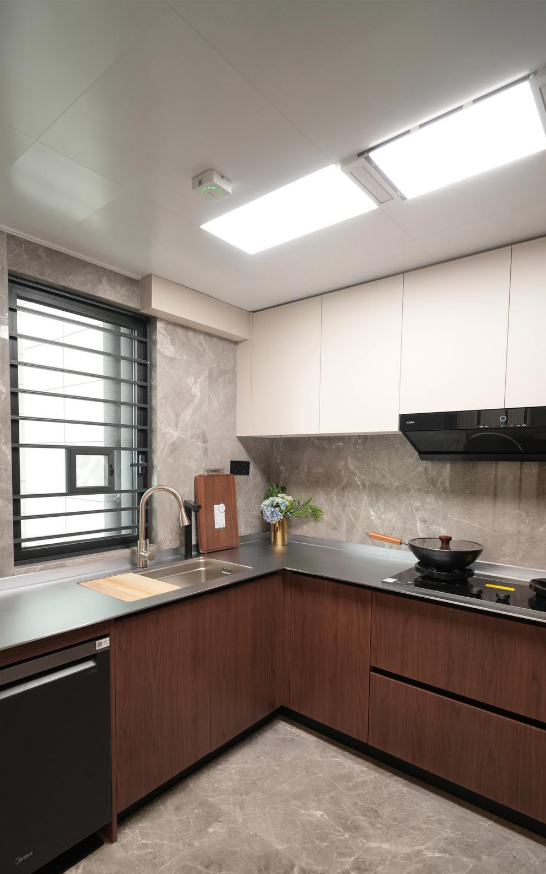
Private apartment, Beijiao, Foshan — an L-shaped run with a one-piece stainless steel worktop and a walnut-grain frame.
PROJECT AT A GLANCE
LOCATION | Beijiao, Foshan, Guangdong, China |
PROJECT TYPE | Private apartment, kitchen |
LAYOUT | L-shaped run, window at one end |
SCOPE | Base and wall cabinets, worktop, sink |
CABINET BODY | 304 food-grade stainless steel |
WORKTOP | Single-sheet bent stainless steel, seamless sink joint |
FINISH | Walnut-grain finish; white wall cabinets |
WARRANTY | 10 years on the stainless steel cabinet body |
Kitchens are the room people agonise over most. The worktop might swell. The cabinet body might soak up the damp. You want it to look good, and you are afraid it will only look good. You have heard stainless steel lasts, and you are afraid it will feel like a canteen.
This is one kitchen in Foshan, Guangdong, photographed after the family had moved back in. We asked the owner what she felt the first time she walked in after it was finished. She said: “I decided on the spot, before the renovation even started. I saw a stainless steel kitchen once, and that was it. I still love this space.”
01
The first look
Her kitchen is not large. It is an L-shaped run in a compact apartment, with a window at one end. What you notice first is how calm it is: white wall cabinets, deep walnut base units, and between them a single unbroken band of stainless steel. No handles asking for attention, no decorative trim.
Light comes in from the window and lands on the worktop, where a bunch of flowers sits in a vase. It does not read as cold. It reads as lived in.
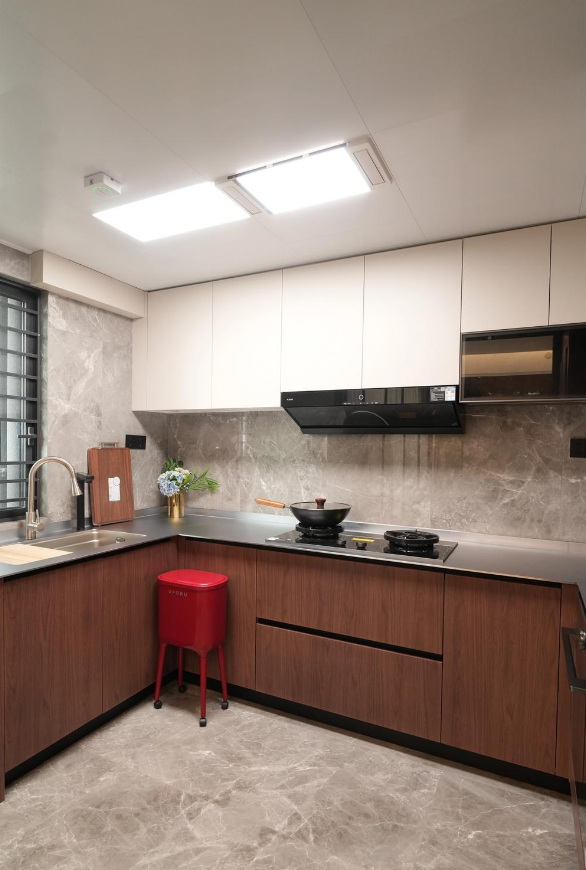
White wall cabinets over walnut-grain base units, with one continuous stainless steel worktop.
I looked at kitchens for the better part of a year. Once I had seen a stainless steel one, there was only one thought left in my head.
02
A good kitchen should not ask you to compromise
Anyone who has been through a kitchen renovation knows what wood-based panels are afraid of: water, oil, and the damp spring season in southern China, when the air sits close to saturation for weeks on end. Cabinet bodies swell at the cut edges. Worktops lift at the joints. Mould takes hold behind the sink and does not come back out.
The usual answer is to go fully stainless — and then worry that it will look like a commercial kitchen, with none of the warmth of a home. This kitchen takes the other route: walnut grain on the outside, stainless steel everywhere it has to work.
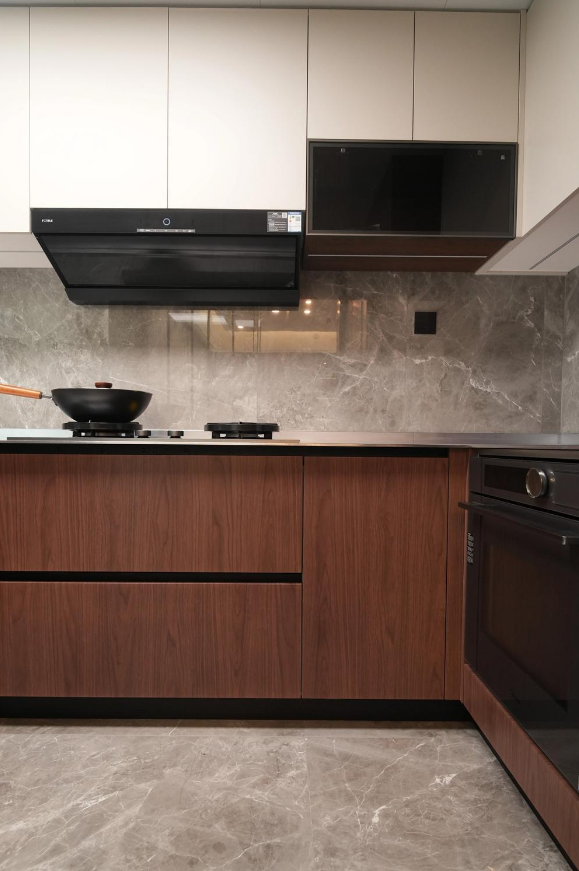
Walnut grain frames the run; stainless steel sits where the work happens.
03
One sheet, bent — the joint is what gets dirty
The dirtiest part of any kitchen is a joint. Where the worktop is pieced together, where the sink is sealed into the top: the silicone darkens, oil settles into the line, and no cloth reaches it.
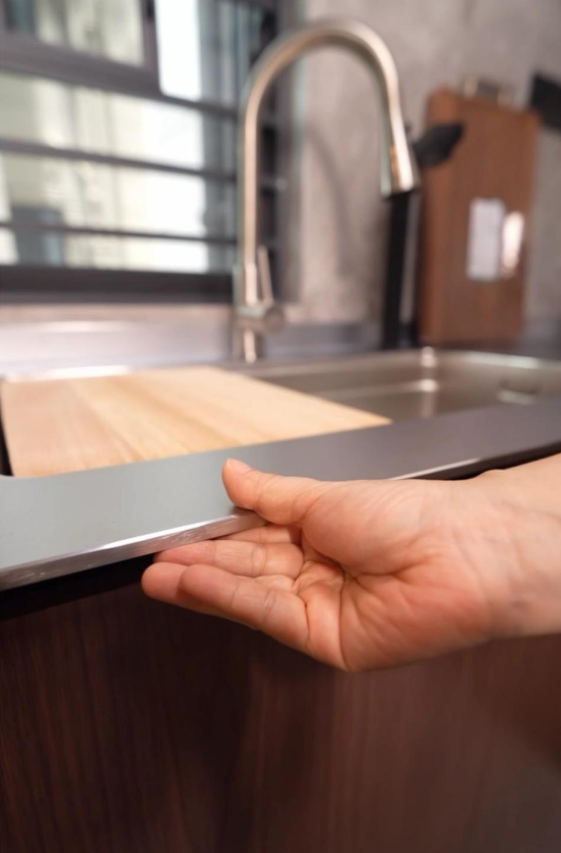
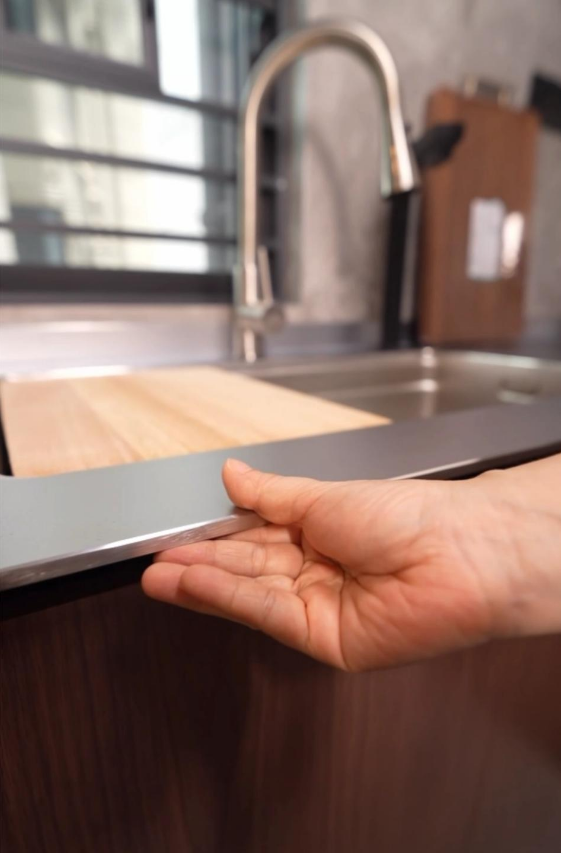
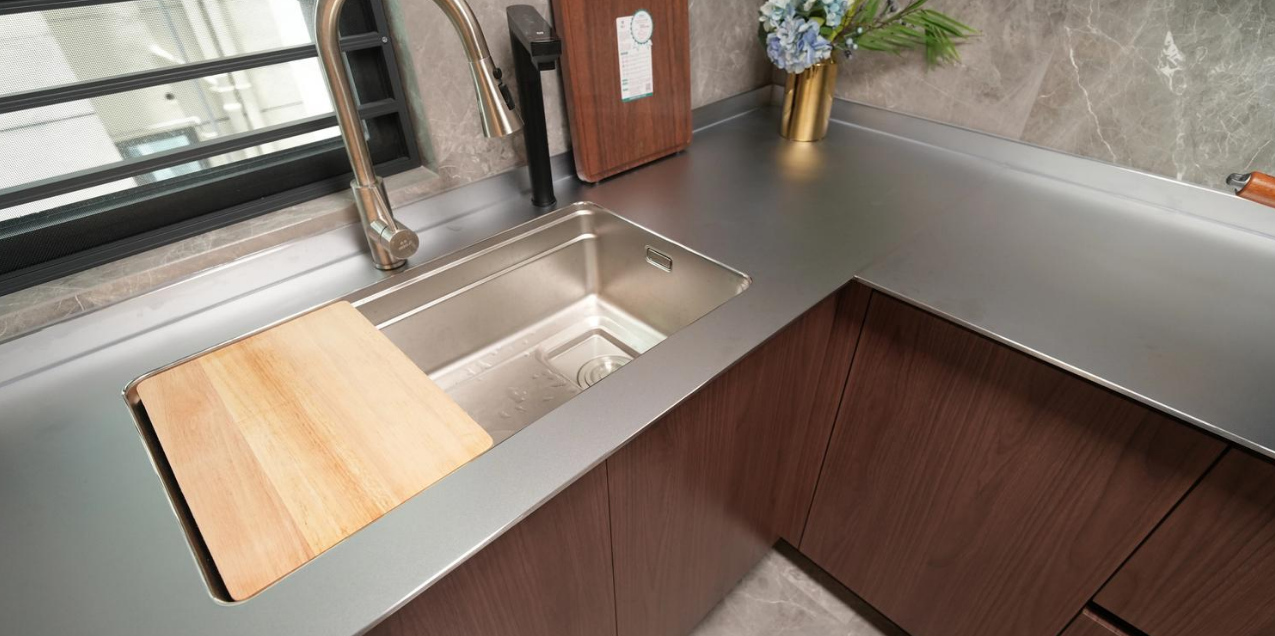
Here the worktop is bent from a single sheet. Sink and worktop are one continuous piece of steel — no silicone bead, no seam, no burr along the edge. Run a hand across it and there is nothing to catch. After cooking, one pass with a cloth and the whole top is clean, corners included.
A hand along the front edge: bent from one sheet, turned down without a joint. |
Worktop and cabinet meet with no visible fixing. |
04
304 stainless steel: heat, water, one wipe
You learn what a stainless worktop is worth by living with it. A pan straight off the gas ring goes down without a trivet. Water flicked from the sink, oil off a stir-fry — one wipe and it is gone. It does not swell, does not take a stain, does not craze.
The grade here is 304, food-grade, the same family of steel used in commercial kitchens.
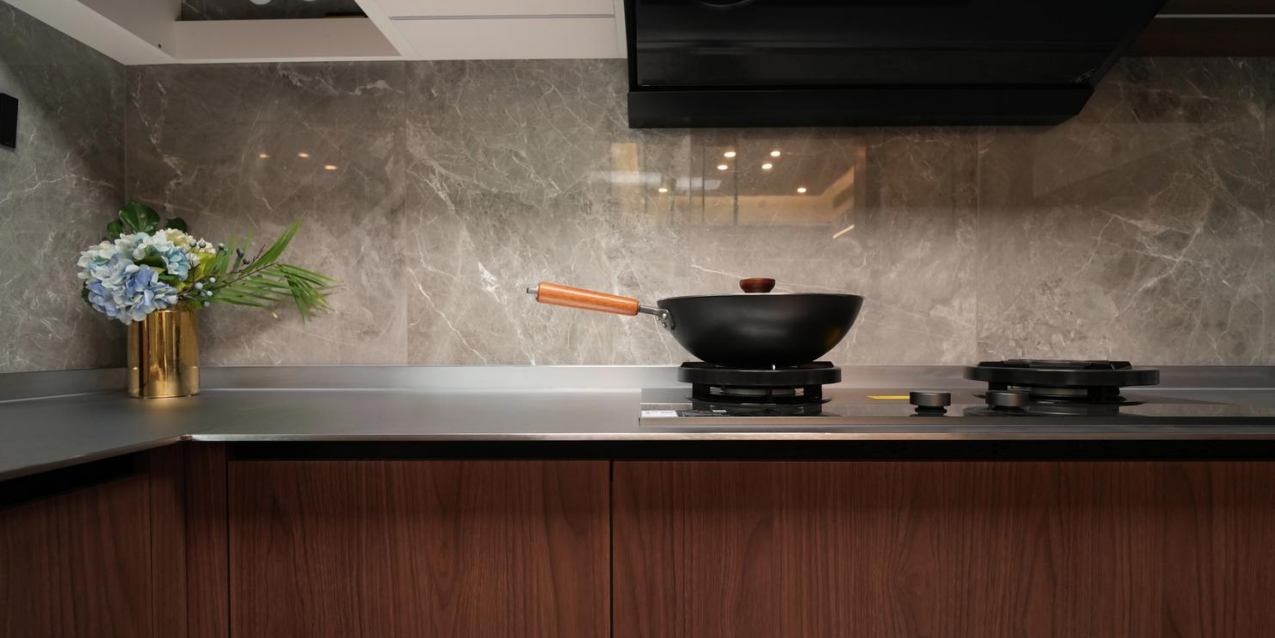
A pan taken straight off the burner, set down without a trivet.
05
A stainless body, even in the damp season
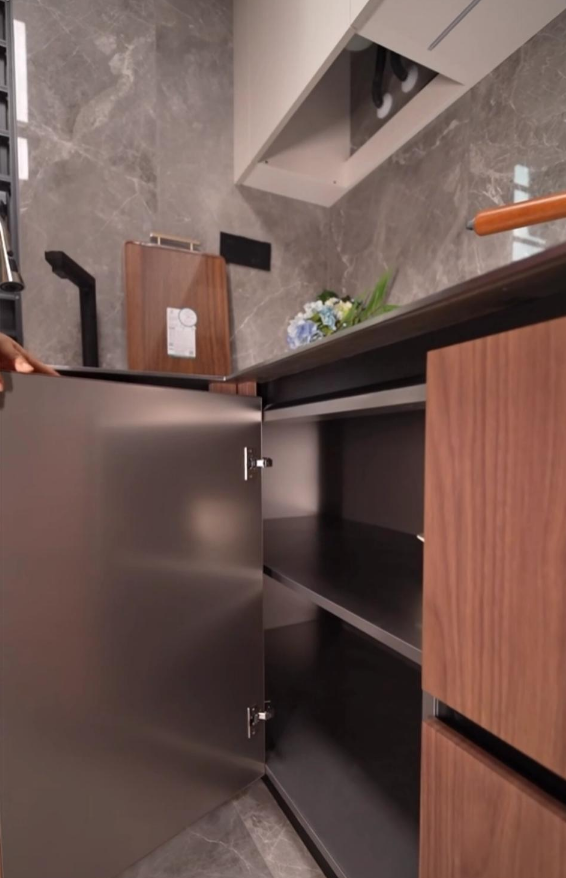
What you cannot see from the doorway matters more. Open a base cabinet and the inside is stainless steel too — not a wood-based carcass behind a steel door.
That means the wettest corners of a kitchen, under the sink and along the wall at the back of the run, are no longer a place where board swells and starts to smell. When the damp season arrives, you close the door and stop thinking about it.
Inside a base cabinet: stainless steel, top to bottom. |
The under-sink zone, where swelling and mould usually start. |
06
Walnut, to take the chill off the metal
Most people still picture stainless steel as cold and clinical. Walnut-grain doors are how this kitchen answers that. The wood tone softens the metal; the crisp stainless edge keeps the wood from going soft. Warm against cool, dark against light, held in proportion rather than piled up.
A good kitchen is rarely the most dramatic room in the house. It is the one that still feels right after years of daily use.
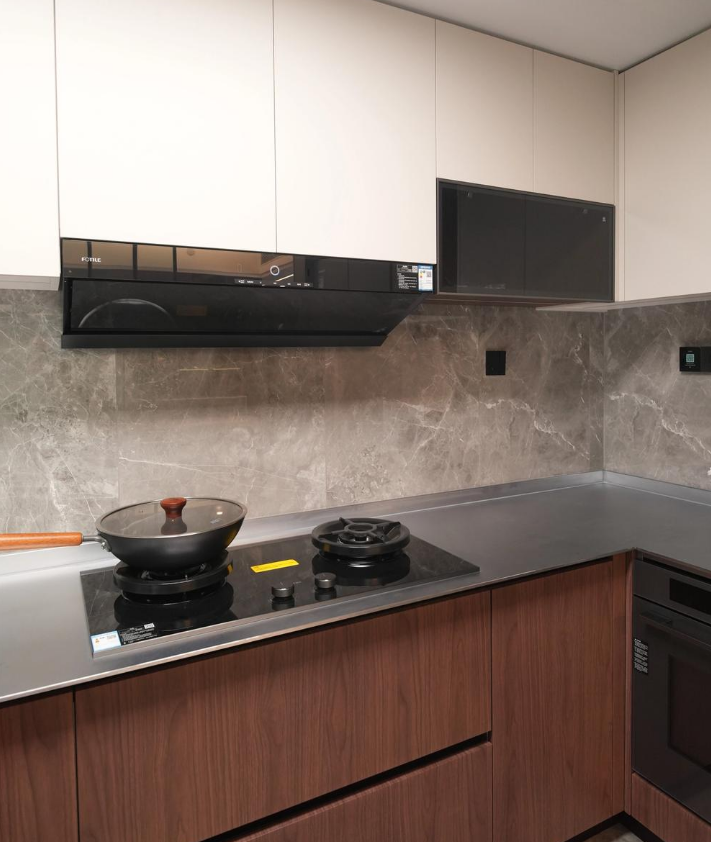
Deep walnut against white, with the stainless band tying the two together.

Worktop, sink and the light coming in from the window at the end of the run.
Asked to sum it up, the owner listed four things: it keeps water out, it does not burn, it is easy to keep clean, and it looks the way she wanted it to. For a kitchen, that is more or less the whole brief.
Building or renovating a kitchen in a humid climate? Request a quotation · eldonyang@jiunaikitchen.com www.jiunaikitchen.com Send us your layout or drawings. We will come back with a quotation, a material schedule and the finishes that suit the space — 304 or 316 depending on how close you are to salt air. |


